A History of Controversy
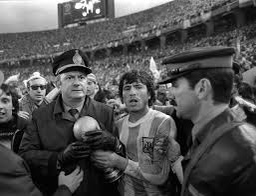
As we are deep into the Qatar 2022 World Cup the football has taken centre stage, but there is still much protest and anger surrounding the tournament. A common feeling being that this World Cup is unlike those that proceeded it. I have taken a look back at the history of the World Cup and controversies that surround the event.
1928 – 2 years prior to the inaugural World Cup the FA withdrew from FIFA with problems over the definition on the amateur status and concerns about FIFA’s power and influence on national associations. This meant that British teams did not enter the first 3 tournaments.
1930 – Uruguay
Only 4 European countries entered due to the difficulties in travel. Uruguay did not enter the next world cup in protest to this.
1934 – Italy
Much like Hitler and the 1938 Olympics, Mussolini used the 1934 World Cup to promote fascism.
There we many rumours of corruption at the tournament and Mussolini’s influences benefitting Italy, who eventually won.
1938 – France
The was outrage in South America that consecutive World Cups were held in Europe
Uruguay & Argentina boycotted the tournament because of this.
Spain did not play because of The Spanish Civil War
Austria withdrew after they were annexed into Germany, star player Matthias Sindelar refused to play for the unified team.
Most controversially, Italy wore all black in their Quarter Final against France as a symbol of the Italian fascist paramilitary.
1950 – Brazil
Following World War II a whole host of teams were absent from this world cup for differing reasons.
Germany & Japan were unable to participate as they were still occupied following war.
Soviet Union, Czechoslovakia & Hungary refused to participate.
France refused to play after the Brazilian organisers would not move their games that were some 3,000km apart.
Argentina withdrew following a dispute with the Brazilian Football Confederation. Ecuador & Peru also withdrew.
India, having remarkably qualified, withdrew after FIFA denied them from playing barefoot. Austria, Turkey, Belgium, The Philippines, Indonesia & Burma also withdrew.
Scotland withdrew because they lost the home nations championship to England and believed only the winner should qualify for the World Cup.
Portugal & Ireland turned down invitations to replace withdrawn teams.
1962 – Chile
This tournament was marred by constant violence on the pitch. The Chile v Italy match dubbed ‘The Battle of Santiago’ with the Italian team needing police protection to leave the pitch.
Italian media had spoken badly of Chile saying that is was ‘pure madness’ to allow Chile to host.
1966 – England
African countries boycotted the tournament in protest after it was ruled there would be no direct qualification for an African team. They also protested against the readmission of South Africa to Fifa in 1963 despite its expulsion from the CAF due to Apartheid.
There were also links with the German team to doping at this World Cup.
1974 – West Germany
In 2008 a former FIFA president claimed that the 1966 & 1974 were fixed for the hosts to win with British & German referees seeing Brazil lose in both.
The Soviet Union were not at this World Cup after refusing to play the second leg of their play off against Chile. A new regime had gathered people deemed undesirable and executed them in the Santiago stadium, the venue for the play off. After FIFA could not agree an alternative venue the Soviet’s withdrew and FIFA saw the match go ahead with Chile kicking off against no opponents and scoring in an empty goal to qualify for the World Cup.
1978 – Argentina
A World Cup surrounded by controversy following the military coup in Argentina 2 years prior. In 1977 over 5,000 people disappeared and, with concentration camps less than a mile from River Plates stadium, the right wing dictatorship used the World Cup as a propaganda device much like Mussolini in 1934.
Johan Cruyff refused to participate after he and his family were kidnapped a few months before the tournament.
Argentina had many favourable decisions in the match and needed to beat Peru by 4 goals to proceed to the final. After endless accusations of match fixing Argentina won the game 6-0.
Argentina went on to win the final against The Netherlands in another controversial game. After being forced to take an extra long route to the stadium, they were then made to wait on the pitch for 10 minutes before the Argentinians appeared, whilst being subjected to abuse from 70,000 baying home fans. It was a brutal game with any 50/50 decision seemingly going Argentina’s way in a 3-1 win.
1982 – Spain
A tournament blighted by violent fouls, poor officiating and overcrowded stadiums.
Noteable violent fouling on Maradona by Italian Claudio Gentile and West German goalkeeper’s horrific foul on France’s Patrick Battiston.
FIFA changed referring regulations following this World Cup to prevent such fouling happen again.
There was consideration given for England, Northern Ireland and Scotland withdrawing because of the Falklands War and Spain’s strong diplomatic ties with Argentina.
West Germany’s final group game against Austria was dubbed the ‘Disgrace of Dijon’ with The German’s scoring after 10 minutes followed by 80 minutes of passing the ball back and forth as the 1-0 victory would see both teams qualify. Final group games were all played at the same time following this world cup.
1986 – Mexico
Some controversy here with Mexico being awarded the tournament. Opposing bids from United States and Canada were overlooked as they criticised FIFA president Joao Havelange and his ties to Mexican television network, Televisa, and the Mexican FIFA vice president. Havelange secretly promised broadcast rights to Televisa before the vote had even taken place.
1994 – USA
An Initially controversial decision over a non-football loving country, who didn’t even have a professional league, hosting a World Cup was quickly pushed to one side. With high average attendances, broadcasting and sponsorship deals saw this become the most financially successful World Cup of all time.
1998 – France
Former FIFA executive committee member, Chick Blazer, confirmed that he and other members of FIFA’s executive committee were bribed during the 1998 & 2010 World Cups host selection process. This 98 bribe turned out to be from a failed Moroccon bid!
2002 – Korea/Japan
This World Cup in its inception was a controversial one. The first ever joint hosts after both countries were forced together after separate bids were deemed unfeasible alone. Along with Japan having never qualified for a previous World Cup and the time difference an issue for many, FIFA was accused of putting political expenditure over the best interest of the fans. Football culture in South Korea at the time was viewed in a similar was as Qatar is now.
During Korea’s knock out wins against Italy and Spain there was a number of very dubious referring decisions leading to many claims of dirty play and cries that the tournament had descended into farce. Both referees for the 2 games were forced to retire shortly after the tournament due to match fixing and being bribed to help South Korea advance.
2006 – Germany
Germany beat South Africa to host and following numerous findings of undue payments and contracts an investigation was opened into Beckenbauer and Germany’s bid in 2016.
It was claimed that ‘foreign-looking’ people should not visit some areas in the former East Germany due to reports of new-nazi’s planned violence. The African Council in Berlin advised black and Asian fans to avoid certain areas.
2010 – South Africa
The 2015 FIFA corruption case reported that South Africa had secured the right to host the world cup by paying $10m in bribes to then FIFA vice-president Jack Warner and other FIFA members. Chuck Blazer also confirmed these bribes in his co-operation with the FBI. It was reported that Morocco had actually won the vote but South Africa was given the tournament instead.
During 2006 and 2007 the were major concerns about South Africa’s preparations and it was rumoured that it could be moved to another country.
In 2009 70,000 construction workers who were working on new stadium went on strike with unions alleging that they were grossly underpaid.
2014 – Brazil
Prior to the World Cup there was much unrest and protests regarding public spending for the tournament. Romario labelled the tournament ‘the biggest theft in history’ believing its real costs would exceed US$45 billion.
There were various issues with safety, including the death of 8 workers, a fire, stadium breaches, a monorail collapse and the collapse of an overpass leaving 2 people dead and 22 injured.
Thousands of homes in Rio’s slums were cleared for redevelopments despite protests and resistance. A Favela, which housed 700 families, near the Maracana was completely destroyed.
2018 – Russia
The selection of Russia as a host was very controversial. Issues included racism in Russian football, human rights abuses by the russian government and discrimination against LGBT people in Russian society. Not to mention the ongoing conflict in Ukraine, particularly following the annexation of Crimea.
The was many allegations, especially from the English FA, of corruption and bribery in the bidding process. Although officially unproven to this date.
In response to the Skirpal poisoning in March 2018 no British ministers or members of the Royal family would attend the world cup. Boris Johnson compared the event to the 1936 Olympics held in Nazi Germany
At the end of the 2018 World Cup, Russia was widely praised for a successful tournament. Perhaps there is more trepidation at the 2022 World Cup in Qatar due to what we have learnt from these past tournaments. And, especially in the most recent case, what may follow.
 Dan Smith Sport
Always learn something new, great post! Daniel Dantas
LikeLike
Thanks for the tips, very useful! Veronica Dantas
LikeLike